Monday, August 19, 2013

The Pearl of Great Price--Pascal's Wager Revisited* *

“Again, the kingdom of heaven is like a merchant in search of fine pearls who, on finding one pearl of great value, sold all that he had and bought it.” (Matt 13:45,46, RSV).


INTRODUCTION.

Blaise Pascal, courtesy "Science Kids" (http://www.sciencekids.co.nz/pictures/scientists/blaisepascal.html )

Among the pile of  Pascal's papers that were to be the “Pensees” was found a proposition that has kept philosophers and theologians occupied for the last 350 years, Pascal's wager:  betting on God is the prudent option. (Notes, below, 1-8)   What new insights can one bring to this, then, after all this time?  I will try to understand the wager from a perspective of contemporary decision analysis, for which the wager was possibly the first instance, and also comment on what happens after one accepts the wager.


First, some background: it is important to keep in mind that although Pascal was a mathematician and physicist of the first order, he did not believe it was possible to show from reason alone that God exists (so much for Anselm and Aquinas!) :

“If there is a God, He is infinitely incomprehensible, since having neither parts nor limits, He has no affinity to us.  We are then incapable of knowing either what He is or if He is.”

On the other hand we can know God by faith:

“But by faith we know His existence;  in glory we shall know His nature.”

The last part of this quote shows the route Pascal wants us to follow: there is an afterlife, and its benefits are infinite.  This being so, the odds for following God are infinite; whatever one might lose in believing, even if there were no God, is finite, whereas that which one can gain from belief,  if there is a God, is infinite:

“But there is here an infinity of an infinitely happy life to gain, a chance of gain against a finite number of chances of loss, and what you stake is finite.”

Pascal spoke as a counselor of gamblers, for whom (with Fermat) he had developed the first quantitative version of probability analysis. It will be useful, before the wager is recast in a more quantitative format, to give some mundane examples.

THE WAGER AS A PROBLEM IN DECISION ANALYSIS.


In contemporary decision analysis one can proceed in two ways:

1) to examine possible gains and losses for various options, in the absence of known probabilities,  and to choose that option  which would correspond (psychologically or economically) to a preferred strategy:

2) to use known or estimated probabilities for various outcomes and to choose the option with the maximum expected value (see below).     Let's  first assume that  probabilities aren't known,  and see what considerations  might be involved in  choosing an option.   Here is the example:

Investing 10,000 units (dollars or ??) in
1) a savings account at 2% interest;
2) a conservative stock portfolio paying 6% in a good market, and losing 10% in a bad market;
3) a sure thing—an unreported diamond mine in Northern Scotland that your Uncle Angus has told you about—you'll double your investment.

The  table below summarizes the possible outcomes;  the columns represent “state of nature”, that is “good” outcome for a particular option and “bad” outcome ( a – sign means a loss), the rows, the different options.

If you're an optimist, you would of course choose the diamond mine.   If you are a pessimist or  risk-averse, you would choose the option with the least possible loss, the Savings Account (you would follow what is called the mini-max principle in decision analysis(9), choosing the option with minimum possible loss).

Now suppose Uncle Angus was right about the diamond mine—you'd berate yourself for not having invested in it.   This regret is quantified in a decision analysis scenario and used to justify a “mini-max regret” approach (10) for decision making.   For each state of nature (column) you subtract the best outcome to give a negative figure for “regret”.    You then list the worst (that is most negative) regret for each row (option) and choose that option with the least negative worst regret, as shown in the following table:


The option with with the least negative worst regret is the diamond mine, so if you were to follow a mini-max regret approach you would choose that option.  Clearly this is the restatement, in contemporary decision analytic terms, of Pascal's choice for belief, absent a known probability for the existence of God.     Put as a table one would have, symbolically:

There aren't numbers here, but clearly the value for belief in the existence of God (and the afterlife),  X, is much greater than Y (the loss -Y one sustains by belief) or Z (the gain of a possibly hedonistic life that one sustains by unbelief), so the minimum worst regret (least negative) is that for belief in God.

If probabilities for outcomes are known or can be estimated, another approach is to use expected values for each option and choose the option with the maximum expected value.   To get an expected value you multiply each outcome value by the probability for that outcome and sum these products for all the outcomes for a given option.

Pascal did not presume to give a probability for the existence of God and the afterlife.  However he relied on the infinite value of the outcome to give an infinite expected value—any number (however small as long as it's not zero) times infinity is infinity. And as long as the imputed loss is finite, the expected value will be infinite.   This assumption has raised the hackles of philosophers, and counterexamples—such as mixed strategies(2,10) and the “St. Petersburg Paradox”—have been proposed to show how the assumption of an infinite value outcome leads to problems.     In particular, suppose one follows the strategy of choosing the toss of a coin to decide  whether to believe.    The probability will be half that you will  choose to believe, so the expectation value will be infinite,  even though there will still be a probability of one-half  that you have chosen not to believe.    In my opinion these are valid objections, but they ignore the thrust of Pascal's argument, that the gain from belief is so large, that for any non-zero probability of an afterlife, the prudent person will believe.    The statement can be best  put in the forms of odds for the existence of God and an afterlife:

If the odds are greater than the possible loss to gain ratio, then  one should make the wager.    For example, if you believe that the odds for  Great Britain winning the World Cup are 2 to 3  and the bookmakers are giving 1 to 8 odds for Great Britain (win 8, lose 1),  you should bet for, and not against Great Britain.

WHO WON'T ACCEPT PASCAL'S WAGER AND WHAT HAPPENS AFTER.


Who are those who would not accept the wager?   According to Nicholas Rescher (1), the following:

1) the hard-core atheist (if you don't believe in God, you wouldn't believe in the possibility of an afterlife);

2) “the all-out hedonist” (Dr. Faustus?);

3) “the all-trusting disbeliever”, that is, one who believes everyone goes to heaven, that as in St. Teresa's prayer, Jesus will lead all souls to heaven, especially those most in need of his mercy;

4) “the radical skeptic” who disbelieves in all knowledge;

5) theists (e.g Buddhists, Hindus) who believe in God but have a different conception of the afterlife;

6) those who believe in an afterlife but in their evil, like Satan, would rather live in Hell than serve the Lord.

We emphasize again that the argument of Pascal's wager is addressed to the prudential man—the agnostic who believes in the possibility of an afterlife (and God)--and is willing to act so as to gain that reward, even in the midst of doubts.  Is belief then a matter of will?  The agnostic accepts the premise of the wager, but says

“ I am so made that I cannot believe. What, then, would you have me do?”

Pascal responds:

“Endeavor then to convince yourself, not by increase of proofs of God, but by the abatement of your passions.   You would like to attain faith and do not know the way;  you would like to cure yourself of unbelief, and ask the remedy for it...There are people... who are cured of an ill of which you would be cured.   Follow the way by which they began  by acting as if they believed, taking the holy water, having masses said, etc.”

Now can one “fake it until you make it” as Pascal suggests?  Or will the sacraments be ineffective, because the motive of the recipient is mercenary?  Which of the Catechism dicta are appropriate,

(1131)”The sacraments are efficacious signs of grace....They bear fruit in those who receive them WITH THE REQUIRED DISPOSITIONS.” (emphasis added)

or

(1128) “The sacrament is not wrought by the righteousness of either the celebrant or the recipient, BUT BY THE POWER OF GOD.”  (emphasis added).

The second suggests that if one prays for faith, then the “top-down” approach will work, starting from the head  and eventually through to the heart 15, or, as Pascal suggests:

“...at each step you take on this road you will see so great certainty of gain, so much nothingness in what you risk, that you will at last recognize that you have wagered for something certain and infinite, for which you have given nothing.”
As a personal note, let me add that Pascal was right and I'll say more about this in a forthcoming blog, "Top Down to Jesus--Bypassing the Road to Damascus".


*This material has appeared, in somewhat different form, as a posting on the Magis Facebook site with a more detailed account of the probability analysis, and as an article in "FAITH" magazine


NOTES:


    1. Nicholas Rescher, Pascal's Wager—a study of practical reasoning in philosophical theology (Notre Dame: University of Notre Dame Press, 1985).
    2. A good summary on the web, with additional references (including other web sites) is given by Alan Hajek: http://plato.stanford.edu/entries/pascal-wager/
    3. Daniel Garber, What Happens after Pascal's Wager—living faith and rational belief (Milwaukee: Marquette University Press, 2009).
    4. Itzhtak Gilboa, Theory of Decision under Uncertainty (Cambridge: Cambridge University Press, 2009), pp. 38-40.
    5. Bas C. van Fraassen, Laws and Symmetry (Oxford: Clarendon Paperbacks, 1989), pp.52-53.
    6. James A. Connor, Pascal's Wager—the man who played dice with God (San Francisco: Harper and Collins, 2006).
    7. All quotations are from Blaise Pascal, Pensees tr.by W.E. Trotter (Mineola, NY: Dove Philosophical Classics, 2003), #233, pp. 65-69.
    8. Paul Bartha, “Taking stock of infinite value: Pascal's wager and relative utilities.” Synthese 154 (2007), 5-52.
    9. James O. Berger, Statistical Decision Theory and Bayesian Analysis (New York: Springer-Verlag, 1985) p.18
    10. ibid, pp. 377, 387.

Friday, August 2, 2013

The Theology of Water--Is Design Intelligent?

"The water that I shall give him will become in him a fountain of living water, welling up into eternal life. This is a new kind of water, a living, leaping water, welling up for those who are worthy. But why did Christ call the grace of the Spirit water? Because all things are dependent on water; plants and animals have their origin in water. Water comes down from heaven as rain, and although it is always the same in itself, it produces many different effects, one in the palm tree, another in the vine, and so on throughout the whole of creation. It does not come down, now as one thing, now as another, but while remaining essentially the same, it adapts itself to the needs of every creature that receives it."  
Quoted in the "Office of Readings" (Monday, Week 7 of Easter),  from a catechetical instruction by St. Cyril of Jerusalem.


Atomic structure of ice; O's represent oxygen atoms;
H's represent hydrogen atoms;  blue lines represent
chemical bonds;  red lines, hydrogen bonds.
The title of this post, "The Theology of Water", is taken from a short story by Hilbert Schenck in a collection of science-fiction stories with a religious theme, "Perpetual Light", which I read several months ago.   
In this story, after fruitless searches in the rest of the solar system, some middle-aged astronaut scientists explore Titan,  the largest moon of Saturn, to find life.     Titan is unique amongst solar system satellites in having an atmosphere, albeit a very cold one.
  
The scientists don't find life in any form, but they do find a strange type of water:  freezing and melting points much lower than "earth" water, but still with the unusual feature of solid water (ice) lighter than liquid at the freezing point, and with other differences in the thermodynamic properties.  The different properties are in fact those that would be suitable for life on this cold world, if life existed.   In testing the Titan water, the scientists turn it into earth-type water and realize that they are the life for which water is intended.

I dispute the essential scientific point of this story, that water at comparable temperatures and pressures would be different on Titan than on earth.    The properties of ice-- its relatively high melting point (compared to what one might expect doing a Periodic table comparison), it being lighter than liquid water--and the unusual thermodynamic properties of water can be  traced ultimately to fundamental bonding properties, specifically to the properties of the hydrogen bond  (see the illustration above), which in turn can be explained (in principle) by fundamental physics--quantum mechanics and electrostatics. 
  
Nevertheless, in telling the story, Schenck makes this important point: the properties of water  are tightly linked to the properties of the planet earth in order to provide an environment suitable for life (that is to say, carbon-based life as we know it).    Here are those properties (and I quote from the story--all temperatures are in degrees Centigrade--0 degrees Centigrade is the normal freezing point of water):
1)  liquid water has a maximum density at 4 degrees.   If it didn't (if the maximum density was at the freezing temperature), the cold water would sink to the bottom of the ocean and earth's  average surface temperature would be more than 20 degrees lower;
2) if the vapor pressure or the unusually high heat of vaporization of water is changed, either too much or not enough cloud would exist, which, in either case, would be a meteorological disaster;
3) if the density of ice is greater than that of liquid water at the freezing point (for most substances the density of the solid is greater than that of the melt), the ice would sink to the bottom of the oceans and the oceans would be perpetually frozen at the bottom, leading to massive winds at the surface;
4) if the high specific heat of liquid water is reduced, the temperature stabilizing effect of the ocean is lowered, and more storms and lower average temperature results;
5) the properties of water are optimized for the tilt of the earth's axis (23.5 degrees from the vertical)--if it were 0 degrees tilt, the temperature stabilizing effect would be too large, with complete cloud cover and ice-caps down to 40 degrees latitude
6) in the story, the properties of water are set for a mean earth temperature that is optimum for metabolism at 98.6 degrees Fahrenheit (and guess to what temperature that corresponds?)

Our biochemistry crucially involves the chemistry of water and hydrogen bonding.   The structure and reactions of proteins, enzymes, and DNA is critically dependent on hydrogen bonding, internally and to other biochemical molecules.    This blog isn't an appropriate context for even an abbreviated biochemistry lesson, but here are some web sites  about biochemistry and about the role of hydrogen bonding in DNA and proteins that will give some simple ideas to start.   


Biologists interested in alien life have considered biochemistries other than carbon-based/H2O.  (See the Wikipedia article on hypothetical types of biochemistry .)   Of these, one based on ammonia, NH3, seems most likely.    However the hydrogen bonds between ammonia molecules are only half as strong as those between water molecules.   Also, the temperature range for liquid ammonia is much lower than that for water, -78 to -33 degrees, so chemical reactions would proceed much more slowly, possibly too slowly for life-sustaining reactions.

So, the chemistry of hydrogen-bonding is one of those "finely-tuned" realities of nature that enable human life to exist.  We recall the Anthropic Principle, used to explain the fine-tuning of physical constants and cosmological facts (among which are the age of the universe and the unlikely existence of a large moon for our planet) that enables the existence of intelligent, carbon-based life.   I have not invoked the improbability of such fine-tuning, because probability, as a quantitative measure, is not properly applied to a single entity, and there is but one universe--we can know no other despite the speculations of metaphysical cosmologists.

How then do we justify the unlikelihood of such fine tuning, cosmological, physical and chemical?    And when I use the term unlikelihood, I'm not referring to the improbability of picking one white ball out of a bag of a zillion black balls.    Rather, I'm saying that we can think of all sorts of other universes, with different physical constants and laws, for which our type of life would not be possible.    Indeed, it is hard to imagine how any of the operative laws/constants might be nudged just a little bit and still allow for our kind of life.

Such fine tuning for hydrogen-bonding physics and chemistry should not, I believe, be tossed as another ingredient into the Intelligent Design" (ID) stew.     As I understand  ID, its principal tenet is opposing the Darwinian model for evolution (common descent).   Proponents of ID argue that gradual changes in form or biochemistry that might enhance survival (the cornerstone of the Darwinian survival-of-the-fittest program) are not sufficient to achieve the drastic differences in morphology and the "irreducible complexity" of various biochemical schemes.   

To my mind this is a "God of the gaps" type argument--to attribute that which we don't understand to specific divine intervention.   Moreover, a God who frames fundamental physics so that variety and complexity grows "naturally" from a unified beginning is much more to be admired and worshiped than a God who assembles, Leggo-like,  all the objects of a Young Earth (including evidence for a 4.5 billion year old earth and a 14 billion year old universe).    Paul Davies puts it very well:

“...the hypothesis of an intelligent designer applied to the laws of nature is far superior than the designer ...who violates the laws of nature from time to time by working miracles in evolutionary history. Design-by-laws is incomparably more intelligent than design-by-miracles.[emphasis added]”  (The Cosmic Jackpot: Why our universe is just right for life." p.200)
"Design-by-laws" (in Davies' felicitous phrase) is just how the anthropic principle can be interpreted.    Since a  full discussion of the anthropic principle would require a much lengthier blog, I'll defer that.   But I would like to end with one further comment.    This is a blog entitled "Reflections of a Catholic Scientist".    And, as a Catholic scientist, my God is much more than a creator, a demiurge who designed the universe engine and pressed the starter button.    My God is a Trinity,  a personal God, who intervenes from time to time in history, who sustains the laws of physics that make the universe-engine chug along, and who came to us in the person of His son, verified by historical revelation.    


Monday, April 15, 2013

God, Symmetry and Beauty in Science II: A Personal Perspective


“Now, may our God be our hope. He Who made all things is better than all things. He Who made all beautiful things is more beautiful than all of them. …Learn to love the Creator in His creature and the Maker in what He has made.“(St.Augustine of Hippo, Commentary on Psalm 39).
“..and there is no doubt of the supreme mathematical beauty of Einstein’s general relativity.” (Roger Penrose,The Road to Reality).
The Einstein field equation, shown above in abbreviated form, is considered by most physicists to exemplify the most beautiful of all physical theories, that of general relativity.  What are the requirements for a beautiful theory and how do these manifest, as St. Augustine has it, the Creator’s handiwork? The beauty is displayed in the mathematics of the theory, in the equations that relate it to the world.  A first requirement is generality/profundity–the equation has to be the basis for understanding a very broad and deep range of phenomena–as Einstein said,
“I want to know how God created this world. I am not interested in this or that phenomenon. I want to know His thoughts; the rest are details.“ (as quoted by A.Zee in “Fearful Symmetry”)
A second requirement is conciseness–what theoretical physicists would call elegance–Hemingway versus Faulkner or James. An equation that covers a page or so of symbols may be important and general, but it would not be beautiful. Much is summarized in the tensor notation of the general relativity field equations, but this beautiful form did not come easily.   It was not the result of sudden inspiration, unlike the lay view of how great science is done, but the result of eight years of dedicated effort, as Professor John Norton so well describes, in his discussion of Einstein’s notebooks: “General relativity was an achievement of creative imagination.”    
A page from Einstein's notebook on the formulation of general relativity--
see linke above to Prof. Norton's web-page
 There are other beautiful equations: Dirac’s equation combining quantum mechanics and special relativity, which led to the discovery of anti-matter and the theoretical basis for particle spin.    And it was Dirac who said “It is more important to have beauty in one’s equations than to have them  fit experiments”, a sentiment with which I am not entirely in agreement.
Dirac's Relativistic Equation for the Free Electron
In this connection, both the theory of general relativity and the Dirac equation have been confirmed experimentally.     General relativity was confirmed initially by the bending of light during a solar eclipse and by its quantitative explanation of the advance in the perhelion of the orbit of Mercury (as well as many other confirmatory experiments since then).
  The Dirac equation explained the existence of electron spin and predicted the existence of the positron (a positively charged electron), found experimentally some four years later. 

There is one other beautiful equation I want to mention, which in my opinion is as important as the two above: Boltzmann’s equation for entropy (S) in terms of thermodynamic probability (W), 

                                       S= k logarithm(W) 

(k is the Boltzmann constant).
Boltzmann's Tombstone;
the Equation  S= k logW
is at the top and the bust is of Boltzmann
This equation (engraved on his tombstone–see picture–and tattooed on my younger son’s arm) justifies the Second Law of Thermodynamics (the scientific version of Murphy’s Law: the universe is running down, no matter what 
                                           or, you can’t unscramble eggs without doing work), 
a physical law that, according to Einstein, will still be true many hundreds of years from now, even if all other theories are invalidated.
GOD, BEAUTY AND MATHEMATICS. 
Given that mathematics and mathematical physics have elements of beauty, what does this have to do with God?    The notion that mathematical truths are Divine is ancient history, going back to Pythagoras and Plato in ancient Greece. Augustine,  and more recently  Cantor (19th Century), argued that infinity is a manifestation of God’s ineffability.   
Why is science is explained mathematically? Or, as the renowned mathematical physicist, Eugene Wigner, puts it in his article, whence “The Unreasonable Effectiveness of Mathematics in the Natural Sciences"?  The question was, of course, answered some 500 years ago by Galileo: 
“The laws of nature are written by the hand of God in the language of mathematics.”

We want to understand the world and to recognize, as Scripture declares, that God looked on His Creation and saw that it was good. When you see children playing with toy cars or other objects and arranging them neatly in a line, you see the first beginnings of a desire for order and sequence.
Mathematics has an intrinsic beauty that is not constructed by our minds, but is discovered by us.   
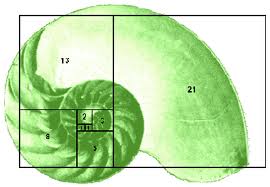
Nautilus shell pattern illustrating the Fibonacci Sequence
(from "Heritage Math", by Savannah Morrow)
In nature, the pattern of sunflower florets, the nautilus shell, the growth of tree limbs is governed by the 
Fibonacci sequence,0,1,1,2,3,5,8,13… The rectangles combined from all the squares of the Fibonacci sequence have sides that have the “Golden Ratio” (“Golden Mean”), which the Greeks appreciated as beautiful proportion.    

 I want to emphasize that the beauty of pleasing proportion comes from more than symmetry.  Symmetry can be an element of beauty, but it neither a necessary element nor always a sufficient element.    It is the apprehension of order, an order that appeals to our intellect, that is the core of beauty.    This appeal to intellect distinguishes beauty from that which is simply good, according to St. Thomas Aquinas:
“The beautiful and the good are the same in the concrete existent (in subjecto), for they are based on the same thing, namely on the form.   For this reason the good is approvingly called the beautiful.  Yet, they differ in their intelligibility (ratione).  For the good appeals to the appetite; indeed, the good is what all desire.  So, it has the intelligible nature of an end, for appetite is sort of a motion toward a thing.   On the other hand, the beautiful appeals to the cognitive power:  for things that give pleasure when they are perceived (quae visa placent) are called beautiful. (emphasis added).   St. Thomas Aquinas,Summa Theologica
Aquinas also requires that which is beautiful be profound (he uses the term “large” or “big” but I think that can be construed as profound, as applied to beauty in science): “Beauty is found in a large body”.
I think Aquinas also shows the connection between Beauty and God in his Fourth Way, (the fourth of five ways of demonstrating the existence of God), which can be stated using the conclusion of the syllogism given in the link, “Thus, there is something that causes the being and goodness of every perfection in all things, and this is God.”
The "Big Trees" of Yosemite Park
(note the small size of the person
in the foreground.)
My own appreciation of the beauty of nature (I was too young and ignorant to realize the beauty of science) came as a teen-ager, going to the Griffith Park Planetarium in Los Angeles, and later, working one summer in the  Forest Service at Yosemite and seeing the Big Trees in their then unspoiled setting.
And all this became reinforced, later on when I became a Catholic (but more of that in a later blog) and saw that all of science was realized in Psalm 19a, “The Heavens declare the glory of God.”

Twitter
Facebook
Link